
Surge protection
What 2,700 joules on a surge protector means, and what it does not
The biggest number on most surge protector boxes is the joule rating. Here is what that figure measures, why it is hard to compare between brands, and which other lines on the label tell you more.
A surge, and where most of them come from
A power surge is a short, unwanted jump in voltage on the line that feeds your outlets. The Electrical Safety Foundation International describes it as a sudden increase that can damage, degrade or destroy sensitive electronics. The dramatic picture is lightning, but ESFI points out that most surges start inside the building itself, when a large appliance such as an air conditioner switches on and off. Others come from switching on the utility grid.
That matters for how you think about a surge protector. It is not a once a summer event the strip waits for. Small surges arrive all the time, and ESFI notes that repeated small ones can slowly wear down electronics and shorten their life. A surge protector sits between the wall and your devices and takes the spike before it reaches them.
It only does that for what is plugged into it. ESFI calls these point-of-use protectors: the computer on the strip is covered, the TV on the outlet across the room is not.
Not every power strip is a surge protector
This is the part that catches people out. A plain power strip, in the words of UL Solutions, is just an extension cord with a lot of outlets. It gives you more sockets and nothing else. ESFI says it plainly: power strips do not provide surge protection, and neither do fuses, breakers or the wiring in your walls.
A surge protector has an extra component inside that clamps the surge and diverts it away from the outlets. On the box it shows up as a joule rating, a clamping or suppressed voltage rating and, on the better ones, an indicator light. If a strip lists none of those, treat it as an extension cord.
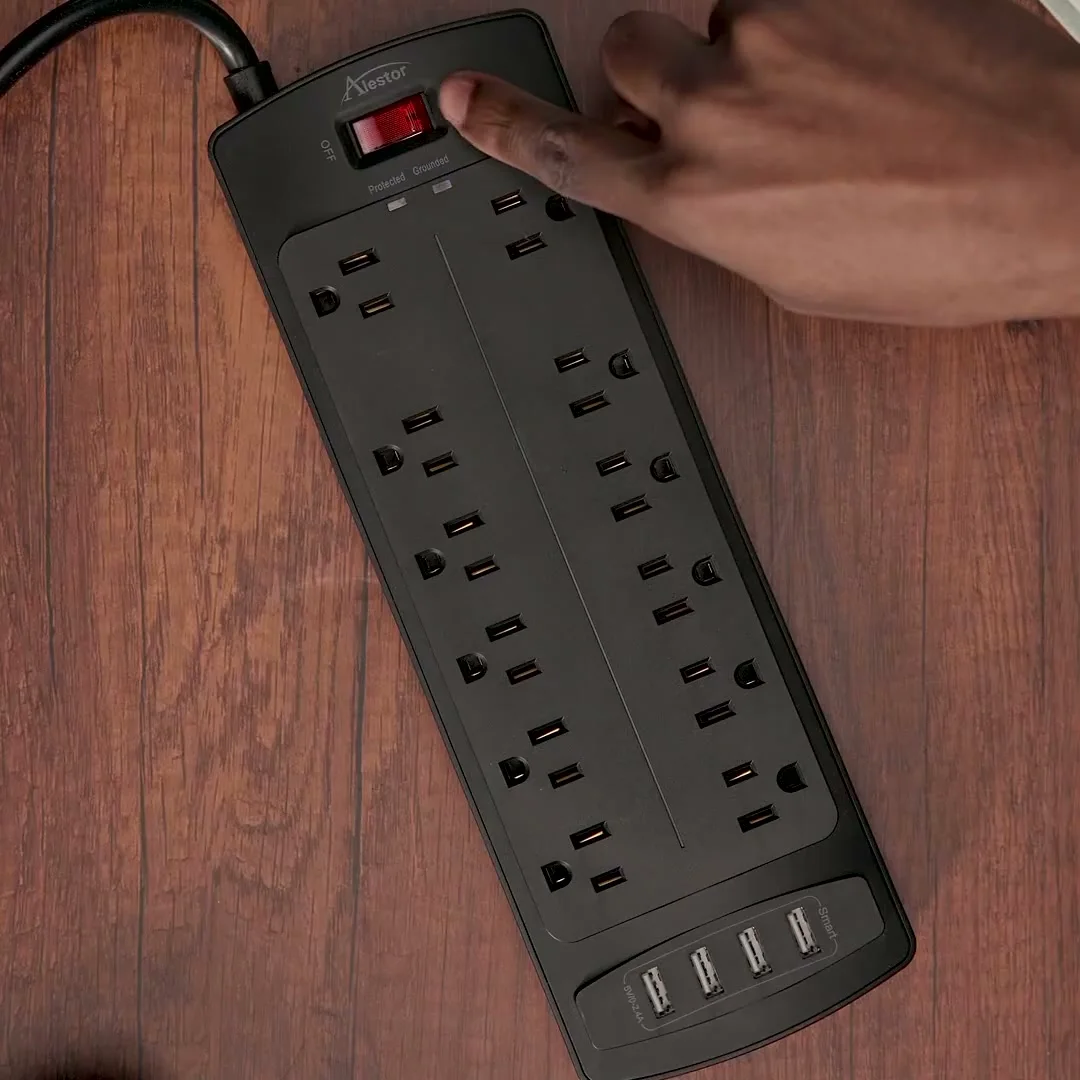
The Alestor strip is a surge protector: its circuit is rated at 2,700 joules and built in three stages, with a light that shows when the protection is working.
What the joule figure measures
A joule is a unit of energy. On a surge protector, the joule figure is an energy rating for the protection circuit, a way of saying how much surge energy it is built to take. That is why it sits in the biggest type on the box, and why more joules sounds like more protection.
The trouble is that there is no single agreed way to measure it. The NEMA Surge Protection Institute, run by the industry's own manufacturers' association, says there is no clear standard for measuring surge protector energy, and that comparing joule ratings can be misleading. It adds that the more reputable makers have stopped quoting energy ratings at all, and that UL standards and IEEE guidelines do not recommend comparing joules.
So a 2,700-joule strip from one brand and a 3,000-joule strip from another are not two points on the same ruler. Each number came out of that maker's own test. You can read the joule figure as a sign the strip has real surge components inside, which a plain strip does not. You cannot read it as a ranking.
The rating the industry prefers: clamping voltage
Instead of joules, NEMA points to the voltage protection rating, or VPR, measured under UL 1449, the standard surge protectors are listed to. It is a let-through figure: how much voltage still reaches your devices when the protector clamps a standard test surge of 6,000 volts. The result is rounded up to one of a fixed set of values, such as 330, 400 or 500 volts.
UL Solutions calls the same idea the suppressed voltage rating and gives its range as 330 to 4,000 volts. Here the logic runs the other way from joules: the lower the rating, the better the protection. Because VPR comes from one standard test, it lets you compare like devices directly, which is what the joule figure cannot do.
OSHA, writing about power strips at work, notes that surge-suppressing strips are listed under UL 1449, while plain strips are listed to a separate standard for power taps.
| Figure on the label | What it tells you | On the Alestor strip |
|---|---|---|
| Joule rating | An energy rating of the surge circuit, measured by each maker in its own way | 2,700 joules, three-stage circuit |
| Voltage protection rating (VPR) | Let-through voltage under the UL 1449 test, lower is better | Not published for this strip |
| Load rating | The most the whole strip can carry, all outlets together | 1,875 W, 15 A at 125 V |
| Indicator light | Whether the surge protection is still working | Protected light, plus a Grounded light |
| Safety mark | The mark of the testing laboratory | ETL Listed |
A cell reads "not published" where the maker gives no figure for the strip.
What is inside the Alestor strip
The 2,700 joules come from three components that share the work. A metal oxide varistor takes the bulk of an ordinary surge. A gas discharge tube handles the larger spikes. A transient voltage suppressor reacts to short, sharp ones. Together they sit between the wall cord and the twelve outlets and the four USB ports.
The strip's published rating has no voltage protection rating or response time, so you will not find either on its label. It does give the load rating, the cord, the outlet layout and the joule figure, and you can find all of them on the product page.
The light that tells you when to replace it
Surge components can fail. NEMA names sustained overvoltage, a raised voltage that lasts rather than spikes, as the leading cause, and from the outside a strip whose protection has failed looks like any other strip. That is why ESFI advises using point-of-use protectors with an indicating light or an alarm that tells you when the protector needs replacing.
On the Alestor strip that is the Protected light at the head. While it is lit, the surge circuit is working. If the strip is switched on and the Protected light is out, replace the strip. Next to it, the Grounded light shows that the ground connection is working, which the protection needs to send a surge away from your devices.
UL Solutions adds that strips have no expiry date. Replace one when the light says so, and also whenever the cord or housing is damaged, frayed or brittle.
Where the protection belongs in a room
NEMA sorts surge protectors by where they sit. A plug-in protector at the outlet is what it calls a Type 3 device, the last stage before the equipment, usually at least thirty feet of wiring away from the electrical panel. It protects the things plugged into it, and nothing else on the circuit.
So the question is not how many joules a house needs, which no source we read tries to answer, but which devices you want on the protected outlets. In most rooms that is the computer and its monitors, the TV with its box and console, the router and modem, and the chargers for phones and tablets. A lamp gains little from surge protection, but it costs nothing to plug it in too.
If those devices are spread across a room, one strip on a long enough cord usually brings them together on one protected set of outlets, which is easier than a protector at every wall outlet.
What no surge protector can do
ESFI is direct about the limit: no surge protection device can handle a direct lightning strike. A plug-in protector at the outlet is the last layer, not the only one. It also does not add power to the circuit. The whole strip still shares the capacity of the one outlet it plugs into, and ESFI puts it this way: strips give more access to the same limited capacity, not more of it.
That is why the joule figure is only one part of choosing a strip. The cord has to reach the outlet without a second extension cord, and what you plug in has to stay within the load rating. Our guides on cord length and on what not to plug into a power strip cover both.
A short checklist for the box
- Look for the words surge protector and a joule rating. Without them, it is a power strip.
- Read the joule figure as proof the strip has surge parts inside, not as a score against other brands.
- If a clamping or voltage protection rating is printed, lower is better, and it compares fairly between strips.
- Make sure there is a light that shows the protection is working.
- Check the load rating against what you plan to plug in, all outlets together.
- Look for the mark of an independent testing laboratory on the strip.
None of these replaces the instructions that come with the strip, and none of them turns a strip into protection against lightning. Together they tell you more than the biggest number on the box.
Comparing our strip with another one by its label? Write to outlets@myalestor.com, and the Alestor team answers with the figures our strip does and does not carry.
